How to use a customer story in your own deals
A playbook for the salesperson, deal by deal: what to learn, what to send and when, the words to send it with, and how to look after the customer who made it possible
 9 min read

A salesperson gets the most from a customer story by learning it well enough to tell in 30 seconds, matching it to prospects whose situation looks like the customer's, and sending one piece at a time: a sentence naming the customer in a cold message, the one short that answers their question once they reply, the one-page sales guide after a first meeting, a quote from their sector in the proposal and the objection buster when the deal stalls. Quote the customer word for word, ask before you put anyone on a reference call, and tell marketing which story you needed and didn't have.
If you sell for an MSP, or look after partners for a vendor that sells through MSPs, someone has probably dropped a folder of customer films, PDFs and quote cards into a shared drive for you, and the pieces that matter most to a salesperson are the ones least likely to get opened.
I've written before about the weekly habit a sales team can build around one story. This post is narrower: your own deals, one at a time, in the order you'll meet each step, with a plain label on every step so you could teach it from a whiteboard.
1. Can you tell the story in 30 seconds without notes?
Learn the story well enough to tell it across a table before you send it to anyone, because the rep who can say it in their own words uses it in conversations a PDF never reaches. The battlecard in every pack we make opens with the story in 30 seconds, and it's a good start, but read it, close it and write your own version in four lines: who the customer is, what was going wrong, what changed, and the one moment worth quoting.
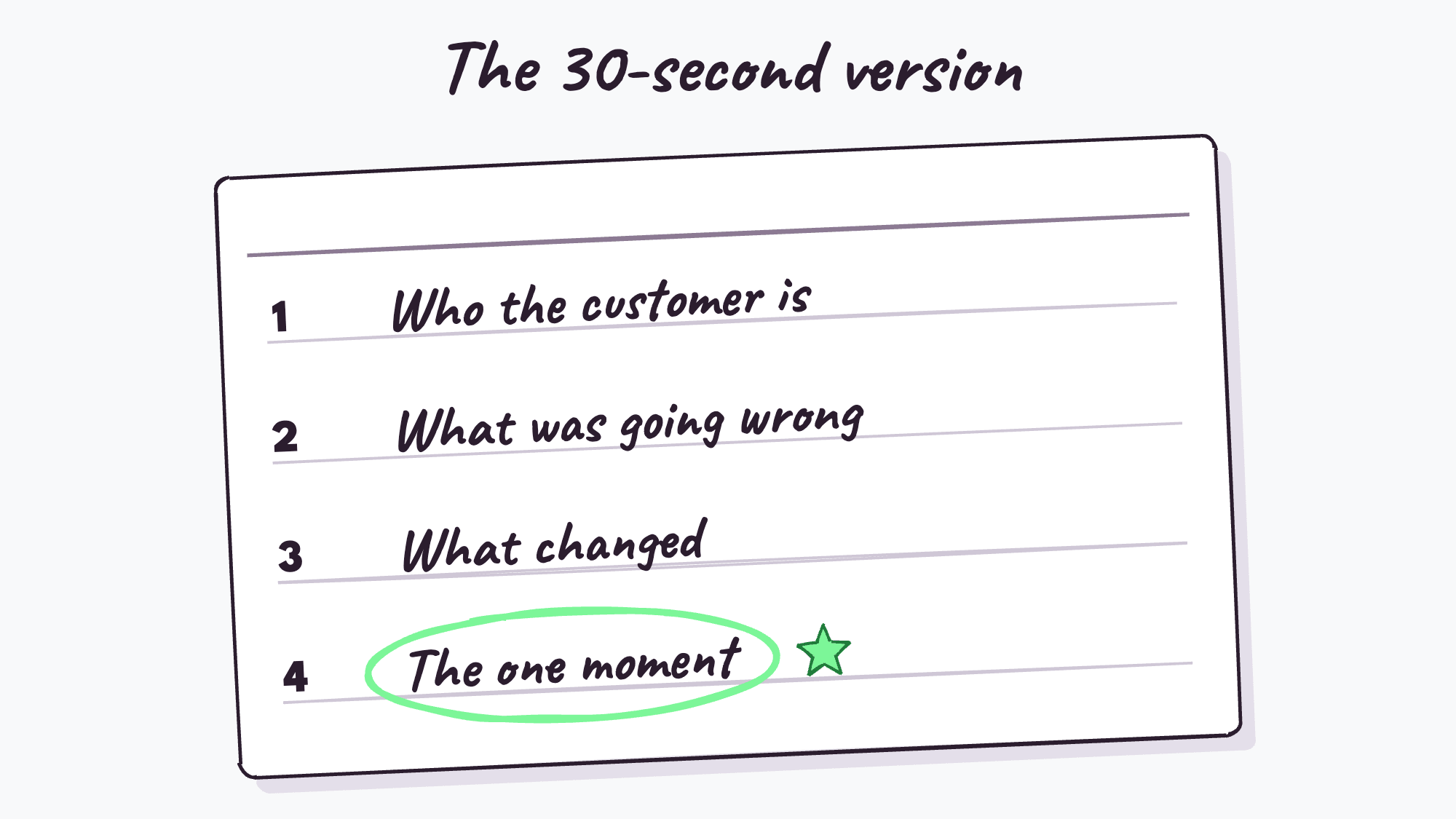
The one moment is the part most people skip, and it's the part a prospect remembers. Patrik Kekonius is a sales manager at Coegi Cloud, an MSP in Gothenburg, and his story for usecure covers phishing, training and policies, but the moment is when he compares his customers who use it with the ones who don't:
you put all of our customers in one big basket and then you pull out the ones using usecure, they don't have any tickets anymore
Know exactly what a line like that means, so you never stretch it. He is talking about tickets on phishing, policies and training courses, and he says the customers without usecure still raise them, which is a claim no MSP owner can pick apart on a call.
2. Does this story look like the person you're talking to?
A story works on a prospect who recognises themselves in it, which is why the most famous logo in the folder is often the wrong one to send. Match on their situation instead: their sector, their size, and the thing that made them start looking.
Two of Urban Network's customer stories show the difference. Cheryl Kearney is CEO of Sycamore Trust, an autism charity in Barking and Dagenham, and her story is for a charity leader worried that changing IT provider will unsettle staff for whom change is hard. Craig Wragg is Group IT Director at IDSL Group, a fire door manufacturer with about 423 people near Mansfield, and his is for an IT manager whose own team lacks the time and skills for servers, networks and cyber security.
Send Craig's story to the charity and you've told them you don't have any charities. If nothing in your folder matches, that's worth reporting, which I'll come to at the end.
3. What do you send, and when?
The mistake I see most often is sending the best thing first, as though the film will do the persuading on its own. Proof should arrive in the order the prospect is ready for it, and each stage gets one piece.
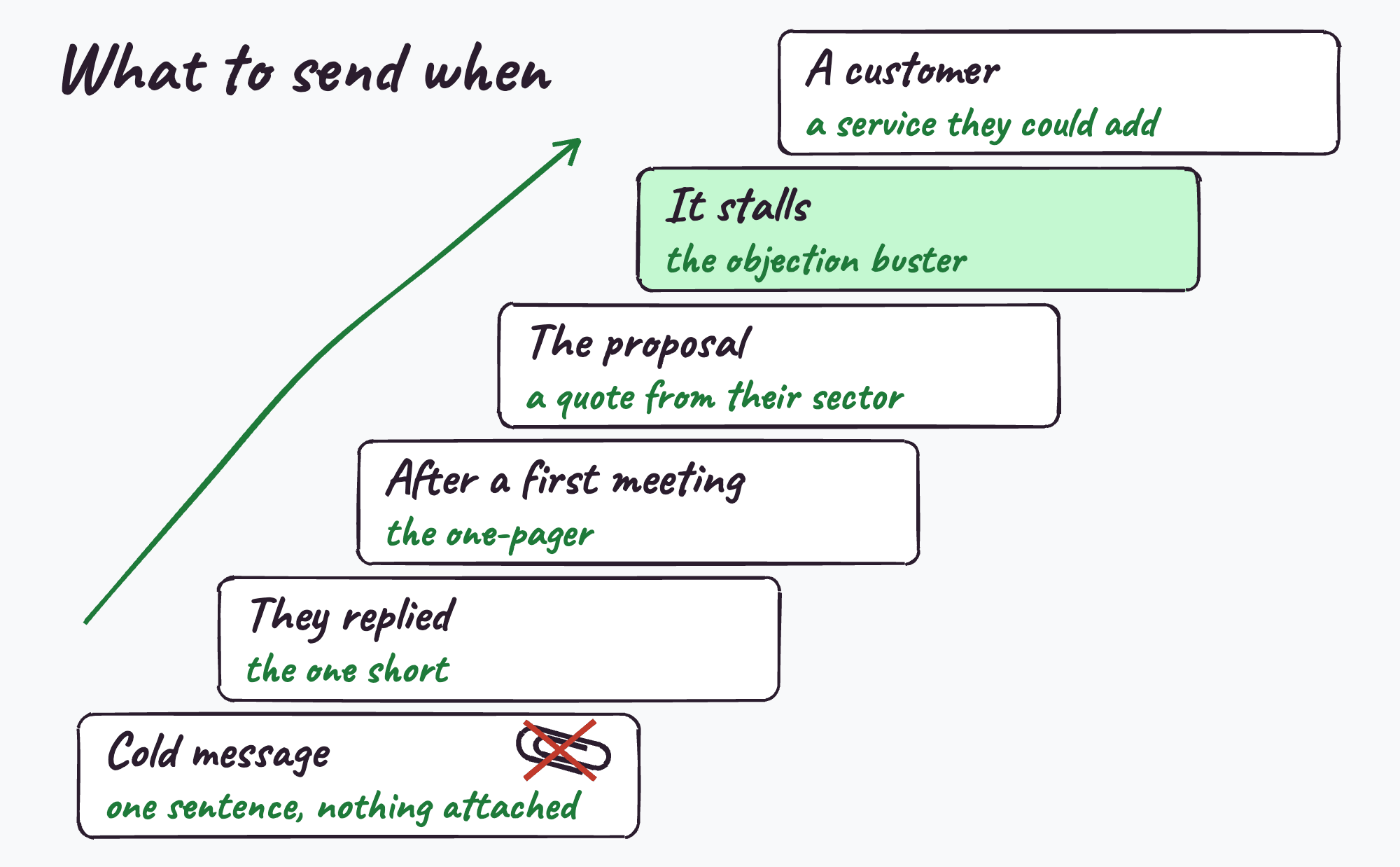
- Cold message: one sentence, nothing attached. Name the customer and one specific detail, and ask whether it's relevant. No link, and don't open with the prospect's problem.
- They replied: the one short. Pick the clip that answers the question they asked, rather than the full film.
- After a first meeting: the one-pager. The one-page sales guide is safe to forward, and your contact nearly always has somebody to convince who you'll never meet.
- The proposal: a quote from their sector. A name, role and company next to the price, where the doubt is highest.
- It stalls: the objection buster. The short made for the worry that stalls deals most, sent with a line naming the worry.
- A customer: a service they could add. More on that in step 7.
The eight-page case study and the full film are for whoever asks for more, usually the person signing, so send them on request rather than as a reflex.
4. What do you write when you send it?
Every send needs two things: a line on why you picked it for this person, and the one moment you want them to catch. "Please find attached our latest case study" has neither, and it reads like exactly what it is, a rep ticking off a task.
If you sold for Urban Network, the first two messages might look like this:
5. How do you use a quote on a call?
Out loud, a customer's words do something yours can't, but only if you say them exactly and say whose they are. On a call with a charity that's nervous about switching, a rep for Urban can say "Cheryl Kearney, the CEO of Sycamore Trust, put it like this" and read it straight:
I actually was really worried about the transition over from our current provider, moving over to Urban, all the new equipment, the phones. I think the whole staff team was so pleasantly surprised that it was really, really smooth.
Resist tidying it up, because "really, really smooth" sounds like a person, and a prospect who later watches the film should hear the words you read them. Take quotes from the battlecard's quote bank rather than a graphic, since quote cards are shortened to fit a square, and never promise a clip of a line the quote bank marks as said in the interview but not on film.
6. When should you offer a reference call?
A reference call is the most generous thing a customer can do for your pipeline, and it's the easiest favour to wear out. Cheryl mentioned in her interview that another local charity had already been in touch to ask who looked after their IT, which is how references happen when nobody arranges them, and that goodwill is worth protecting.
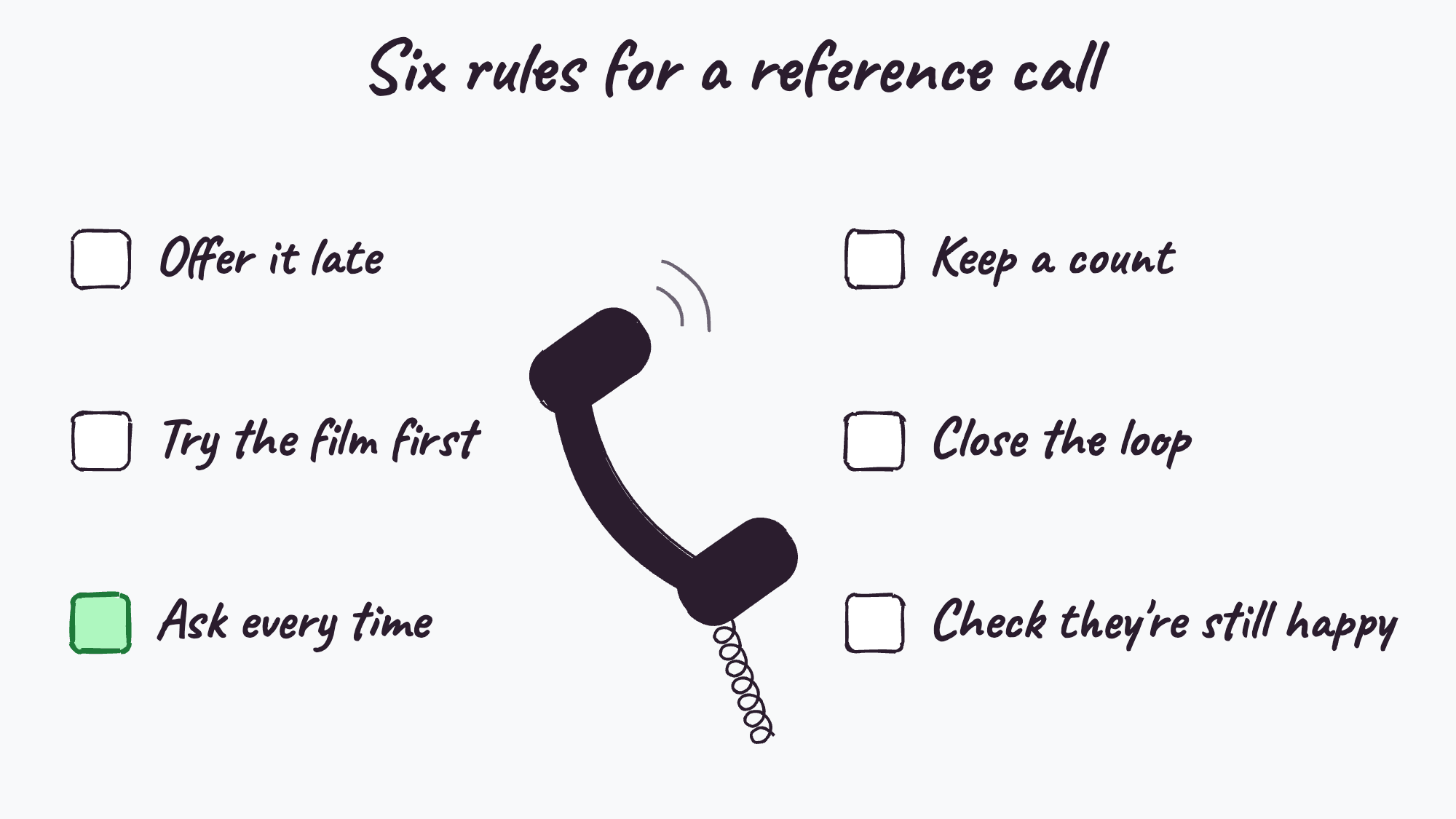
- Offer it late. When the prospect is close and has one worry left.
- Try the film first. The verdict short lets a prospect hear the customer without taking up the customer's afternoon.
- Ask every time. Tell the customer who's calling, what they're worried about and how long it should take.
- Keep a count. Note who you've sent their way, so nobody is rung by three reps in one month.
- Close the loop. Tell them how it went, and thank them whether you won or not.
- Check they're still happy. If they've left, or your contact has moved on, don't make the call.
7. What about the customers you already look after?
Most customer stories are about switching provider, and an existing customer has already switched, so they do little in an account review. What works in a quarterly review or before a renewal is a story about a service a similar customer added later, and our packs tag those service shorts EXPAND for exactly that conversation. Open with the peer rather than the price and let the customer ask the question, as I cover in the role of testimonials in account management.
8. Have you told marketing which story you needed?
The most useful thing a salesperson can hand marketing is a note of every deal where you reached for a story and nothing fitted: the sector, the size, the worry and the service they were weighing. Marketing chooses who to ask for the next testimonial, and without that note it tends to choose whoever is friendliest, which is how a business ends up with five stories about the same kind of customer. Keep the note in your CRM and send it over once a month.
Where does a story earn its keep: finding leads or closing them?
Mostly closing them, and MSP owners on r/msp say as much. One owner who wins most of their leads through search put it plainly: "these leads are more difficult to close compared to referrals. So having a solid sales process, good social proof such as reviews, etc. helps converting them into clients." A referral arrives with someone already vouching for you, and a stranger from Google or a cold list doesn't, which is the gap a customer story fills in the meeting and the follow-up.
The clearest before-and-after I've seen is an older post from a salesperson at an MSP, describing what changed once they had case studies to send:
I rarely have the "why you" conversation anymore. I need to go on the road less because people already trust us. Sales that would have taken 2 - 4 meetings now take 1 - 3.
So judge a story by what it does in steps 3 to 6 above, rather than by how many leads it brings in on its own.
What should you never do with a customer story?
- Attach a film, a PDF or a link to a first cold message.
- Send the whole folder, or "please find attached our case study".
- Put quote marks around your own tidier version of what a customer said.
- Send the wrong sector's story because it's the only film you have.
- Put a customer on a call without asking them first.
When isn't this the right approach?
If nothing in the folder matches the prospect, a sentence about a similar customer does more than an irrelevant film, and the gap goes on your note to marketing. If the deal is small and quick, one quote in the proposal is plenty, and walking through every stage would slow down a sale that didn't need slowing.
And if the customer has left, or the person on film has moved on, check how long a testimonial stays useful before you send anything. Think twice, too, when the prospect competes head to head with the customer in the story, and ask whether that customer would be happy to help a rival win.
Questions people ask
What is the best customer story to send a prospect?
The one whose situation looks most like theirs: the same sector, a similar size and the same reason for looking. A well-known logo from a different world usually does less.
Can you change a customer's quote to make it clearer?
Only if you drop the quote marks and describe what they said in your own words. Anything inside quote marks should be word for word, with the name of the person who said it.
Related reading
- How sales teams use a testimonial every week
- Which client should you ask for a testimonial?
- How channel vendors use MSP partner stories
Every pack we make leads with a sales battlecard: the story in 30 seconds, the objections it answers and the quotes to use word for word, so your team has something for a live deal the week it lands.
See how it worksJames interviews MSP and tech vendor customers for a living and runs MSP Testimonials, the interview-led testimonial service. If a customer of yours has a story worth telling, this is how it gets told.